

Simply closer
to financial markets
Example: breakdown of model validation for FX pricing models
A concrete view of an independent validation — here for FX pricing models — from theoretical soundness through to live-portfolio behaviour.
Theoretical soundness & documentation review
Model assumptions, derivation and limitations, against the documentation.
Product-pricing benchmarks
Model × product comparison — first-generation exotics and TARFs across types, with model-dependency analysis.
Numerical analysis
PDE convergence and PDE-vs-Monte-Carlo agreement; grids, stable schemes and smoothness of Greeks.
Model reserves & prudent valuation
Fair-value and prudent-value adjustments (FVA / AVA).
Front-office model replication
Independent re-implementation / challenger models to characterise a vendor or in-house model.
Market data & calibration benchmarking
Implied and local volatilities, calibration quality and stability.
Payout validation
Payoff handling, event scheduling, fixings and exercise; PDE and Monte-Carlo engines validated independently.
Live-portfolio & scenario tests.
Behaviour across stress and market scenarios on a real portfolio.
Independent price verification
IPV using consensus-pricing services, with mixing-factor recalibration where relevant.
Compliance & governance review
Roles, tiering and policy alignment, woven into the validation record.
Calibration check — FX Local Volatility model
One concrete step from the independent and highly automated validation of the FX Local Volatility model: the calibrated Local-Volatility surface (Lv) is checked against an independent challenger calibration (SmileEu) across 5Δ × 9 tenors. Both reproduce every raw market pillar to numerical noise — the maximum implied-vol deviation is 1.0 bp against a 4.0 bp threshold, so the calibration check passes across the full surface, including the short end.
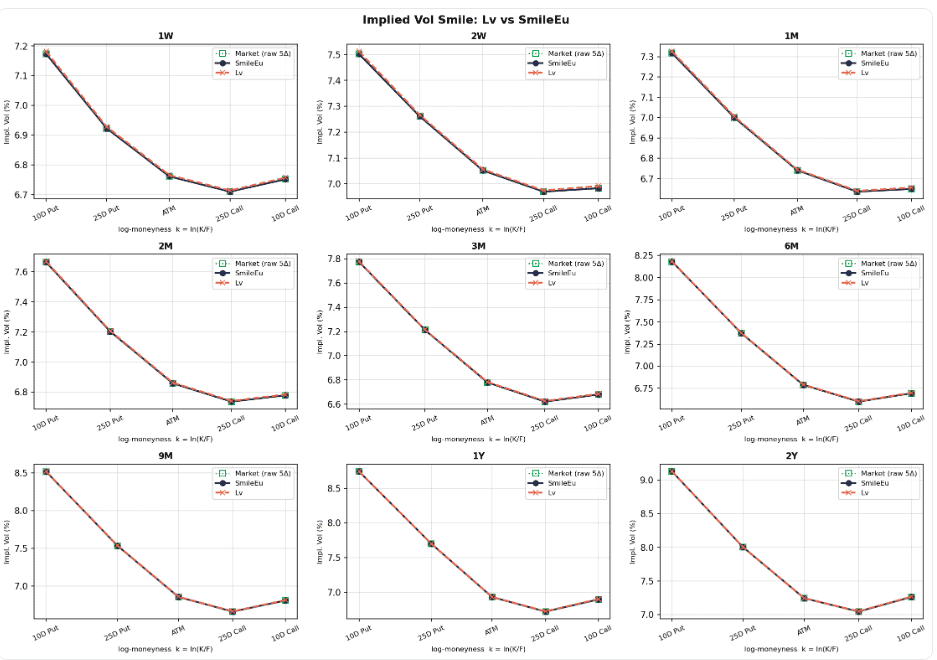
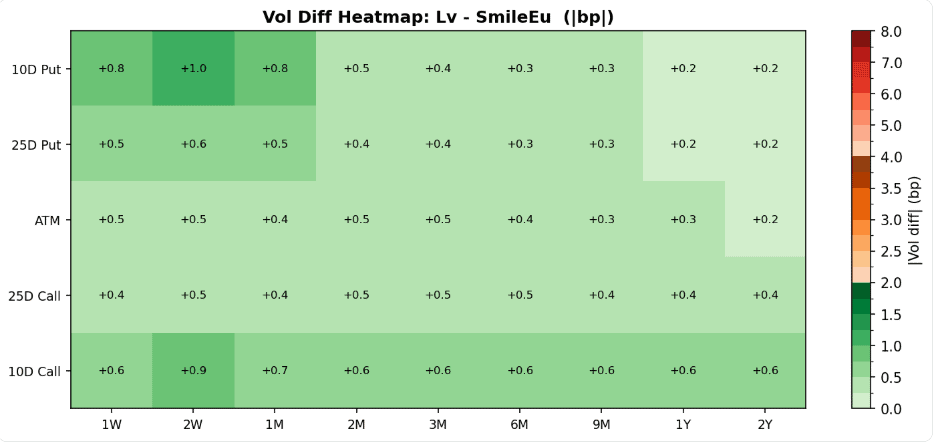
Top: implied-vol smile per tenor (1W–2Y) — raw 5Δ market pillars (green), the independent challenger SmileEu and the model’s Lv overlay in close agreement. Bottom: heatmap of the residual (Lv − SmileEu) in implied-vol basis points; all cells stay well inside the 4 bp tolerance, with a maximum of 1.0 bp.
Address
Kaiserstr. 50
60329 Frankfurt am Main, Germany
modelriskmanagement@mathfinance.com